
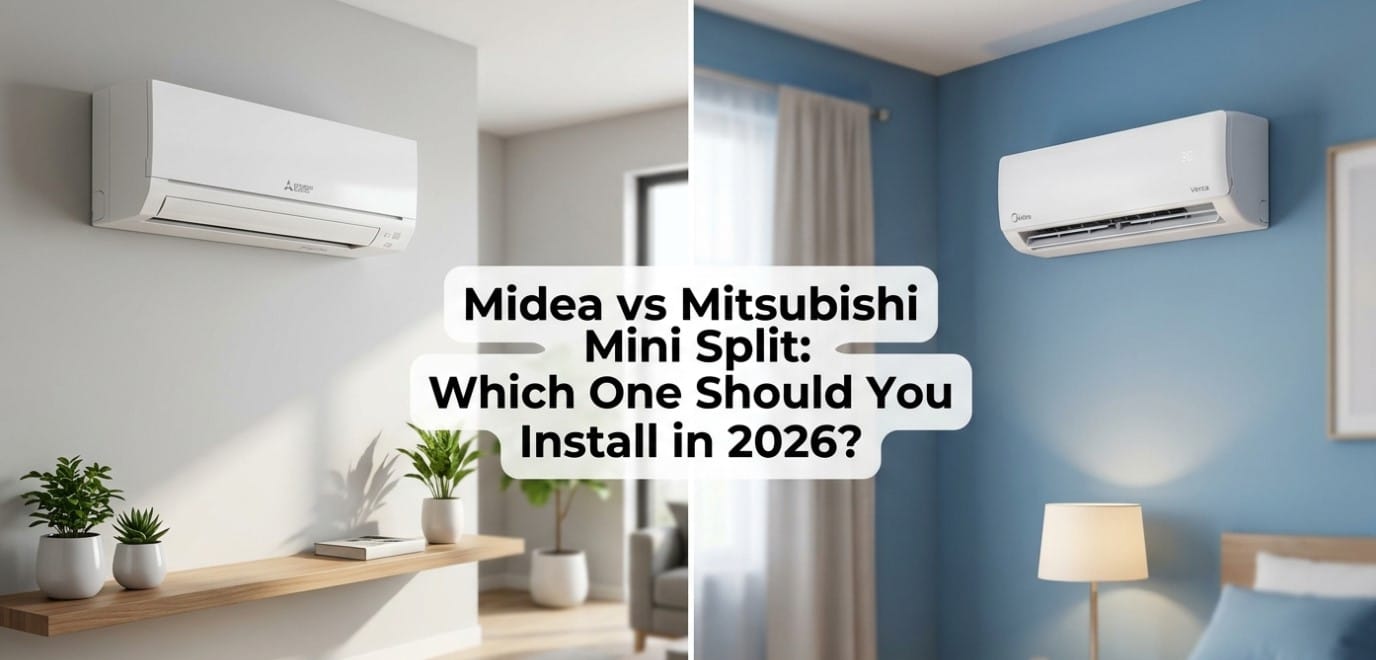
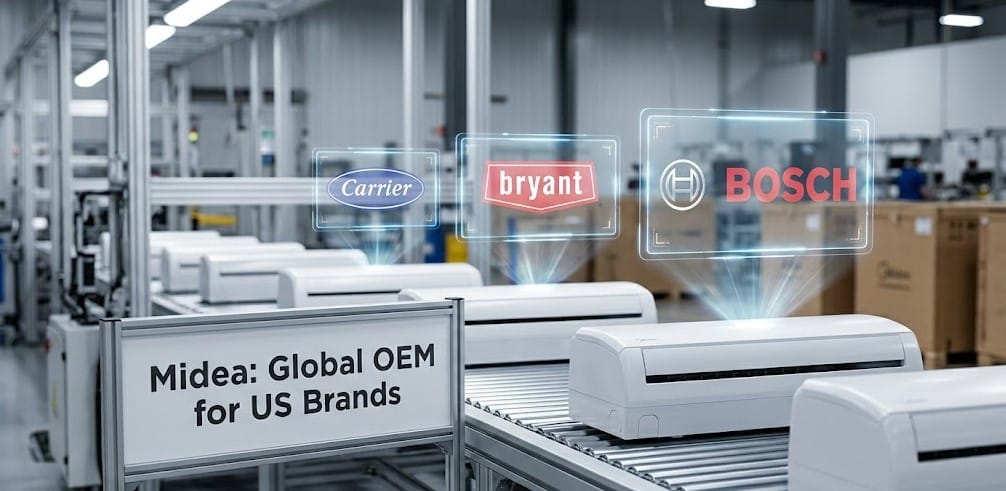
These two brands represent opposite ends of the ductless market — and not in the way most people expect. Mitsubishi invented the mini split category in North America. Midea is the world’s largest HVAC manufacturer by production volume, and quietly makes the ductless units sold under Carrier, Bryant, and Bosch brand names in the US.
That second fact changes how you read every “brand comparison” you’ll find online.
Quick Answer — Midea or Mitsubishi?
Midea costs roughly half as much to install and delivers comparable performance for most Oregon homes. Mitsubishi carries a stronger warranty at the top of its lineup and has a longer track record in the US market — but for most budgets, Midea is the practical starting point.
If this is supplemental cooling for a bonus room, a rental property, or any install where budget matters — Midea. If it’s replacing your primary furnace, you have specific noise sensitivity, or you want the full 12-year Mitsubishi warranty — Mitsubishi is worth the premium.
Midea and Mitsubishi — Brand Overview
Two very different companies, both making genuinely good equipment. What separates them isn’t quality on paper — it’s depth of track record, installer network, and what happens when something breaks in year eight.
Mitsubishi Electric — the Premium Standard in Ductless
Mitsubishi brought ductless heat pump technology to the US market in the 1980s, before most American contractors knew what a mini split was. The M-Series and P-Series lineups have accumulated enough real-world install data — from Alaska to Florida — that the reliability numbers are well-documented, not just claimed.
The Hyper Heat line extended cold-climate operation to -13°F with meaningful heating output retained at that temperature. The Diamond Contractor network means certified installers who’ve completed factory training and have access to extended 12-year warranties not available through uncertified dealers. That network matters more than it sounds — a mis-sized or poorly commissioned mini split will underperform regardless of brand.
Midea — the Affordable Challenger (and the Brand Behind Carrier/Bryant Ductless)
Midea is a Chinese manufacturer that became the world’s largest HVAC producer by volume. In the US market, they’re best known to consumers as Midea — but they’re better known to contractors as the OEM behind Carrier’s ductless line, Bryant’s ductless line, and Bosch heat pumps.
That means if you’ve gotten a quote for a Carrier or Bryant mini split, you’ve already gotten a Midea quote. The hardware is the same. The nameplate and the dealer margin are different.
Key fact: Midea manufactures mini splits sold under the Carrier, Bryant, and Bosch brand names in the US.
Midea’s own-brand units have grown in availability and reputation over the last several years. The Aurora and Versa lines are solid performers at a price point Mitsubishi can’t match. The H2i cold-climate line is rated to an impressive -22°F — a spec that beats Mitsubishi on paper.
Midea vs Mitsubishi Air Conditioner — Cooling Performance
Oregon summers are mild. The question isn’t whether either system can cool a house on a 95°F day — both can. It’s how efficiently they run during the long stretches of 65–75°F weather when the system is cycling at 30–40% capacity.
Efficiency Ratings Compared
| Model Line | Brand | SEER2 | EER2 | Capacity Range |
| M-Series (MSZ-GL) | Mitsubishi | Up to 22 | Up to 14 | 6,000–24,000 BTU |
| P-Series (PUZ) | Mitsubishi | Up to 20.5 | Up to 13 | 9,000–36,000 BTU |
| Versa | Midea | Up to 20 | Up to 13 | 9,000–24,000 BTU |
| Aurora | Midea | Up to 22 | Up to 14 | 9,000–36,000 BTU |
At the top of each lineup, the efficiency numbers are nearly identical. The gap opens up in the mid-tier — Mitsubishi’s M-Series holds efficiency better at partial load, which is where Oregon systems spend most of their operating hours.
Cooling Features That Matter in Oregon
Variable-speed inverter compressors are standard on both brands at any tier above entry-level. That’s the feature that matters most for Oregon’s climate — the ability to run at 40% capacity for hours without short-cycling. Short-cycling (the system turning on and off repeatedly because it can’t modulate) is what drives humidity problems and comfort complaints. Avoid single-stage units in this climate entirely.
Mitsubishi’s i-see Sensor on the FH series detects room occupancy and adjusts airflow accordingly — a feature Midea doesn’t match at comparable price points.
Midea vs Mitsubishi Heat Pump — Heating Performance
This is where the comparison gets more interesting, and where the spec sheet tells a different story than field experience.
Cold Climate Performance — Hyper Heat vs H2i
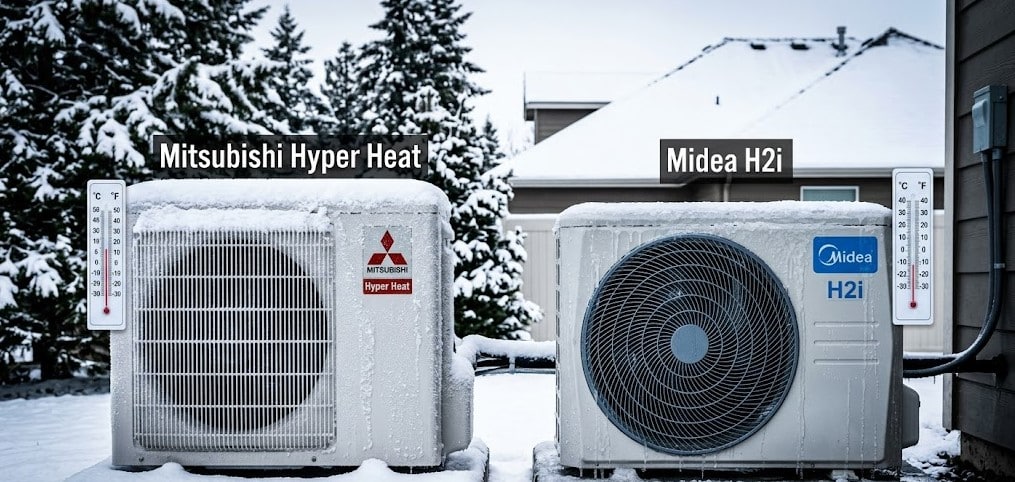
On paper, Midea’s H2i wins: rated to -22°F vs Mitsubishi Hyper Heat’s -13°F. Both numbers are real — these systems maintain heating output at those temperatures. For Oregon homeowners, neither threshold is especially relevant. The Portland metro averages fewer than 10 days below 25°F per year.
What matters more in the Pacific Northwest: rated heating capacity at 17°F and 47°F — the standard low-ambient test points. At these temperatures, both systems perform well. Mitsubishi has more published real-world performance data at these points simply because it’s been installed in more Oregon homes over more years.
Why Heat Pump Performance Matters in the Pacific Northwest
Oregon’s heating season is long and mild — not cold. Temperatures hover between 30–45°F from November through February. This is actually where inverter-driven heat pumps shine: they’re most efficient at partial load, which is exactly what mild weather demands.
A Mitsubishi Hyper Heat and a Midea H2i both handle this well. The practical difference for heat pump installation in Beaverton: the Mitsubishi has a longer track record in this specific climate, and more local contractors have data on how it performs across a full Oregon heating season.
Noise Levels — How Quiet Are They?
On spec sheets, Mitsubishi pulls ahead. In most real-world installations, the difference is less noticeable than the numbers suggest.
Indoor Unit Noise
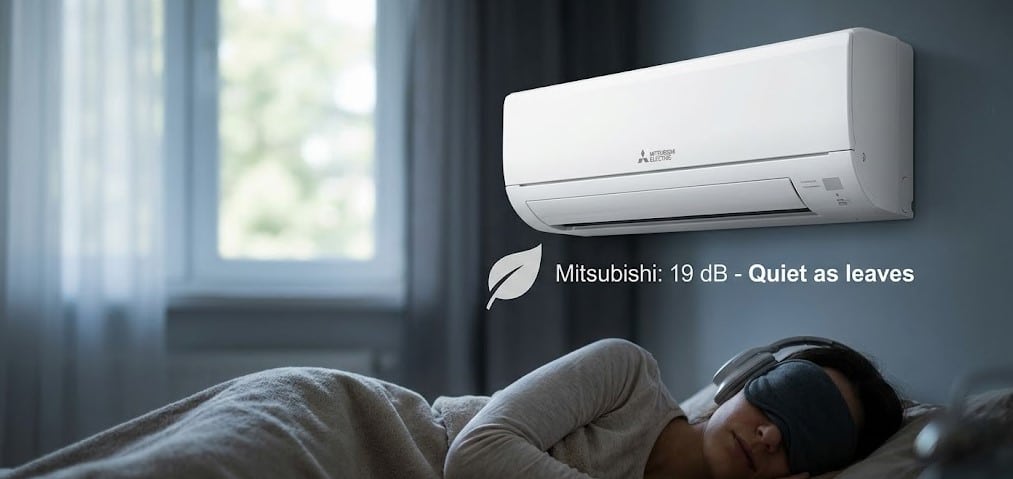
- Mitsubishi MSZ-FH: as low as 19 dB — roughly equivalent to rustling leaves
- Midea standard indoor units: typically 26–32 dB — comparable to a quiet library
The gap exists, and it’s real. For most homeowners in a living room or hallway install, both brands run below the threshold most homeowners notice in daily use. Where the difference shows up is in dedicated quiet spaces: a light sleeper’s bedroom, a nursery, a home recording setup. At 19 dB, the Mitsubishi FH series disappears into the background in a way that 32 dB units don’t quite manage.
Outdoor Unit Noise
Both brands land in the 45–55 dB range at full load — roughly equivalent to moderate rainfall. At partial load the gap narrows further. For most installations, outdoor unit noise from either brand is unremarkable.
Reference scale: 19 dB = rustling leaves / 32 dB = quiet library / 45 dB = quiet suburban street / 55 dB = light rain on a window.
If noise sensitivity is genuinely a priority — bedroom unit, nursery, thin interior walls — the Mitsubishi FH series is worth the premium. For standard living spaces, Midea’s noise levels are competitive with what most homeowners consider acceptable.
Cost and Installation Pricing — Midea vs Mitsubishi
Equipment Cost Comparison
| System Type | Midea (installed) | Mitsubishi (installed) |
| Single-zone, 12,000 BTU | $1,500–$2,800 | $3,000–$4,500 |
| Single-zone, 18,000–24,000 BTU | $2,200–$3,500 | $3,800–$5,500 |
| Multi-zone, 2–3 heads | $4,500–$7,000 | $7,000–$12,000 |
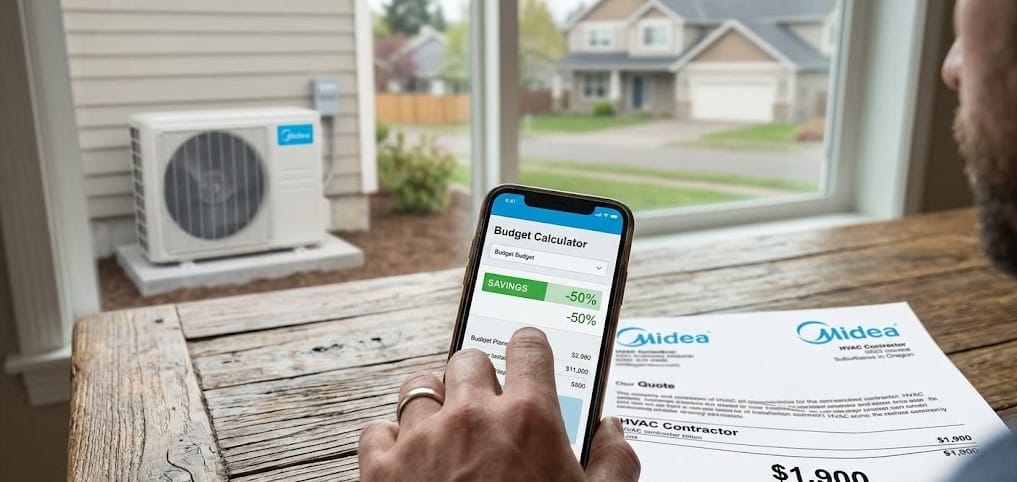
Midea’s price advantage is real and consistent — roughly 40–50% less for comparable capacity. For a single-zone supplemental system, that gap is easy to justify choosing Midea. For a multi-zone primary heating system replacing a gas furnace, the math gets more complicated when you factor in lifespan and repair costs over 15 years.
Total Cost of Ownership Over 10 Years
A Mitsubishi system at $4,500 installed with a 15–20 year lifespan and lower repair frequency can end up cheaper than a Midea system at $2,500 installed that needs a compressor at year nine. This isn’t a hypothetical — compressor replacements run $800–$1,500 in parts alone. Mitsubishi’s 12-year compressor warranty covers that window entirely.
In practice, compressor failures before year 10 are uncommon on either brand with proper maintenance. The warranty difference matters most as insurance, not as a prediction of likely repairs.
Oregon Rebates and Federal Tax Credits for Mini Splits
Both brands can qualify for federal 25C tax credits — up to $2,000 for heat pumps meeting efficiency thresholds. Energy Trust of Oregon offers additional rebates on qualifying ductless heat pumps, typically $300–$800 depending on the system and installation type. Check the current Energy Trust schedule before finalizing equipment selection, as rebate amounts update periodically.
For mini split installation in Oregon, ask your contractor which models on their quote qualify — not every Midea or Mitsubishi unit meets the efficiency requirements for both programs.
Warranty and Lifespan
Warranty Comparison Table
| Coverage | Midea | Mitsubishi |
| Compressor warranty | 7 years | 12 years (Diamond Contractor) |
| Parts warranty | 5 years | 12 years (Diamond Contractor) |
| Labor warranty | Varies by installer | Varies by installer |
| Transferable to new owner | Yes | Yes |
The Mitsubishi 12-year warranty requires installation through a certified Diamond Contractor and registration within 60 days. Without Diamond Contractor installation, Mitsubishi’s standard warranty drops to 5 years — same as Midea. Verify your installer’s certification before assuming you’re getting the extended coverage.
How Long Do They Last?
Mitsubishi: 15–20 years is typical with regular maintenance. There are Oregon installs from the early 2000s still running. Midea: 10–15 years is a reasonable expectation for current-generation units, with less long-term field data available simply because the brand hasn’t been in the US market as long.
Neither number is guaranteed — both depend heavily on installation quality and annual maintenance.
Build Quality and Installer Network in the US
Mitsubishi Diamond Contractor Network
Diamond Contractors complete factory training on system design, commissioning, and diagnostics. They have direct access to Mitsubishi technical support and the extended 12-year warranty program. In Oregon, most established HVAC contractors carry the Diamond certification — it’s become a standard credential for ductless work.
The network also means faster parts access. Mitsubishi maintains US parts distribution that keeps common components in-region. For mini split repair services, that translates to days, not weeks, on most service calls.
Midea Installer Availability
Midea doesn’t have an equivalent certified network in the US. Contractors who install Midea-branded units are often the same ones installing Carrier or Bryant ductless — which means they’re working with Midea hardware whether they know it or not. Midea-specific technical training is less standardized, which matters more when something unusual fails.
The growing availability of Midea units through electrical supply houses has made them easier to source — but easier sourcing doesn’t replace installer expertise on diagnostics and commissioning.
Who Should Choose Midea and Who Should Choose Mitsubishi
Choose Midea If…
- Budget is the real constraint and the system is supplemental — one room, a garage, an addition
- This is a rental property or a home you plan to sell within 5–7 years
- You want ductless cooling added without a major investment
- Your contractor installs Midea regularly and has local service experience on the brand
Choose Mitsubishi If…
- Noise sensitivity is a genuine priority in a specific room — the FH series at 19 dB is the quietest option in residential ductless
- This is a primary heat source replacing a furnace, not supplemental cooling
- You’re staying in the home 10+ years and want the 12-year compressor warranty to mean something
- You want a certified Diamond Contractor installation with full warranty access and factory-backed support
The installation quality determines more of the outcome than the brand. A Midea system commissioned correctly — proper refrigerant charge, correct line set sizing, tight flare connections — will outperform a carelessly installed Mitsubishi every time. Ask your contractor how many units of each brand they’ve installed in the last 12 months. High volume means they’ve seen the failure patterns.
FAQ — Midea vs Mitsubishi Mini Split
Is Midea a good mini split brand? Yes — with caveats. Midea makes solid equipment, and as the OEM behind Carrier, Bryant, and Bosch ductless lines, their manufacturing capability isn’t in question. The gaps compared to Mitsubishi show up in noise levels, warranty depth, and long-term lifespan data. For budget-conscious applications, Midea is a legitimate choice.
Are Carrier mini splits made by Midea? Yes. Carrier’s ductless mini split line is manufactured by Midea. The same applies to Bryant ductless and Bosch heat pumps. The hardware is Midea-designed and built; the nameplate and distribution channel are different.
Which is quieter — Midea or Mitsubishi? Mitsubishi’s FH series is rated lower — as low as 19 dB vs Midea’s typical 26–32 dB. In most living spaces, both brands run quietly enough that homeowners stop noticing within days. The difference becomes relevant in noise-sensitive applications: light sleepers, nurseries, recording spaces. For standard installs, Midea’s noise levels are competitive.
How long does a Midea mini split last compared to Mitsubishi? Mitsubishi: 15–20 years typical. Midea: 10–15 years typical. Mitsubishi has more US field data behind that number. Both figures assume proper installation and annual maintenance.
Which mini split brand is better for Oregon’s climate? Both handle Oregon’s mild, wet winters well — performance at the temperatures that actually occur here is comparable between the two brands. Based on our installation and service experience in Oregon, Midea offers strong overall value: comparable performance in most residential applications at a significantly lower cost. Mitsubishi is worth the premium for specific use cases: primary heat source, noise-sensitive rooms, or long-term ownership where the 12-year warranty is a priority.
Can you get tax credits for Midea or Mitsubishi mini splits? Both brands have models that qualify for the federal 25C heat pump tax credit (up to $2,000) and Energy Trust of Oregon rebates. Qualification depends on the specific model’s efficiency rating, not the brand. Verify with your contractor before finalizing equipment selection — not every model in either lineup meets the threshold.
For most Oregon homeowners, Midea is the practical choice — comparable performance, lower upfront cost, and contractors increasingly familiar with the hardware. Mitsubishi earns its premium in specific situations. Either way, the contractor matters as much as the brand.

 (503) 785-9715