
Home Heating System Repair
Doesn’t matter if it’s a gas furnace, a heat pump, or a ductless mini-split — when the heat stops, you need it fixed today. Conrad Heating and Cooling repairs all residential heating systems throughout Beaverton and the Portland metro. Call 503-785-9715.
Customers rate us a 4.9 out of 5  on Google.
Our Heating Services

Heating Installation
New furnace, heat pump, or ductless system — load calculation, equipment selection, permits, same-day startup. Every unit sized to the space, not to what’s on the truck. Free estimates, financing available.

Heating Repair
Something’s wrong — the system’s short-cycling, not keeping up, or making a sound it didn’t make last winter. Our technicians carry the parts that close most repairs on the first visit. Diagnostic first, written quote before anything gets touched.

Heating Maintenance
The igniter that breaks in February was already weakening in October. A fall tune-up catches it. Maintenance agreement customers get priority scheduling and 10% off repairs.
Expert Home Heating Repair for Beaverton Families
A gas furnace and a heat pump fail differently — different parts, different diagnostic order, different things to carry on the truck. An igniter swap on a 90% AFUE Lennox takes a different approach than tracing a reversing valve fault on a Daikin heat pump. Conrad’s technicians are trained on both, and on the ductless systems that neither category fits neatly.Beaverton-based since 2019. CCB-licensed, EPA 608-certified, no subcontractors. Most Portland metro calls are same-day. Emergency heating repair runs 24/7.

Home Heating Systems We Repair
Complete Home Heating Repair for Every System
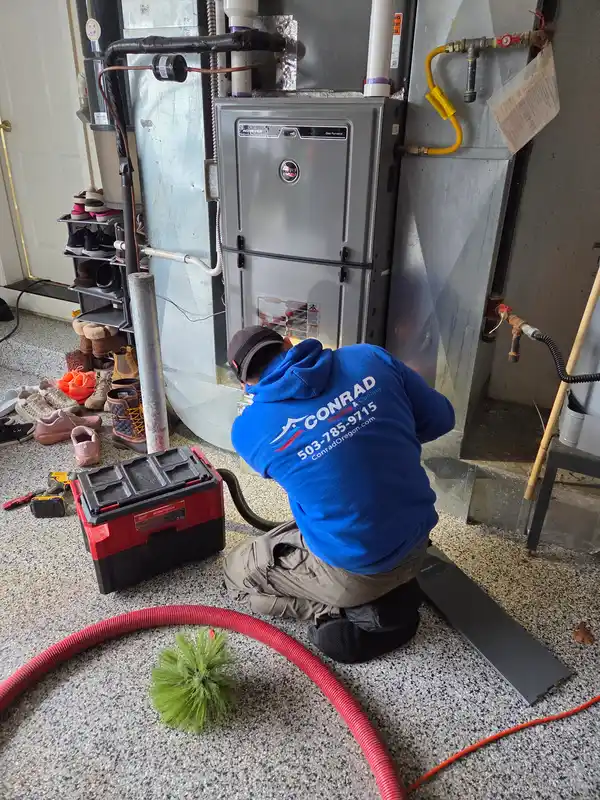
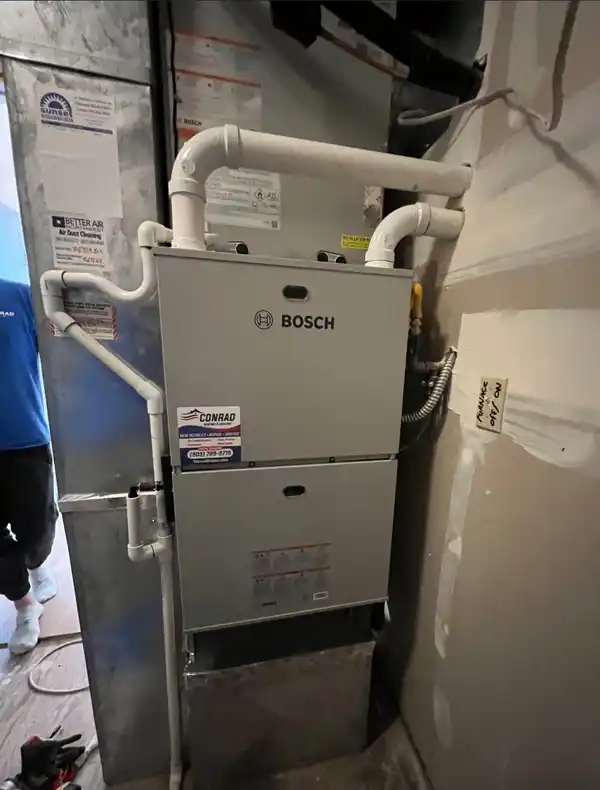
Gas furnaces — igniters, flame sensors, gas valves, burners, heat exchangers (crack detection included), blower motors, draft inductors, control boards. Igniter failure is most common. Cracked heat exchanger is most serious — CO gets into the airstream.
Electric furnaces — heating elements, sequencers, relays, control boards. No combustion, no CO risk, but a different diagnostic sequence than gas.
Heat pumps — reversing valve faults, refrigerant charge, defrost cycle issues, compressor diagnostics. Usually fail as “can’t keep up” rather than “no heat.” That distinction matters for the diagnostic.
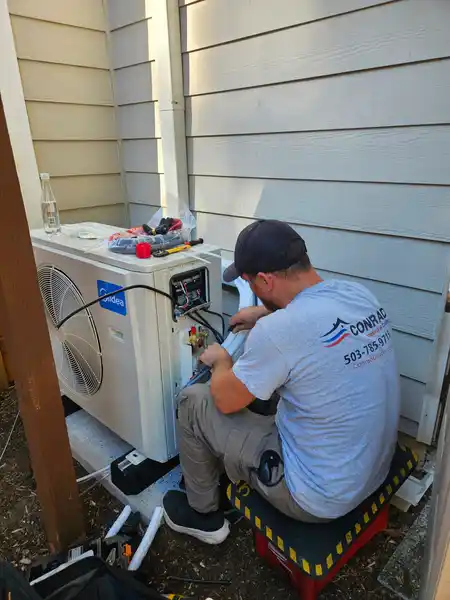
Ductless mini-splits — fan motors, refrigerant leaks, sensor faults, drainage. Individual head failures are isolated — a fault in one zone doesn’t pull the others down.
Signs Your Home Heating System Needs Repair
Last two on this list — don’t call from inside:
- No heat or weak output — system runs, nothing warm comes out; igniter, flame sensor, gas valve, or refrigerant
- Short-cycling — kicks on, runs a few minutes, shuts off; high-limit switch, dirty filter, or overheating
- Startup banging — delayed ignition; gas accumulating before the burner lights
- Screeching — blower motor bearing; announces itself before failing completely
- Rising bills — 15–20% spike without usage change; something is working harder than it should
- Yellow pilot flame — gas burner burns blue; yellow is incomplete combustion
- Gas smell — furnace off, leave without touching switches, gas company first, then Conrad
CO alarm — out now, doors open as you go, 911 first, then 503-785-9715
How Our Home Heating Repair Service Works
Call comes in — live dispatcher, not a recording. Address logged, technician sent. On-site, the tech runs a full diagnostic: not a look at the symptom that triggered the call, but the whole system.
Written quote before anything is touched. That number is the invoice number — nothing changes between estimate and billing. Repair done, full cycle run to confirm it holds, written summary left before we leave.Most calls close on the first visit. Conrad carries igniters, flame sensors, capacitors, blower motors, reversing valves, and control boards for major brands. More detail by system type: furnace repair | general heating repair
Home Heating Repair Cost
What Home Heating Repair Costs
Most repairs land between $150 and $600. Igniter and flame sensor replacements sit at the lower end. Blower motors, reversing valves, and control boards push higher. Written quote after diagnostics, before work starts — free on repair calls.
If the repair math doesn’t hold, Conrad reviews replacement options at the same visit. No second appointment to get numbers.
Why Deferring Repairs Gets Expensive
A failing flame sensor causes short-cycling. Repeated short-cycling trips the high-limit switch. Chronic high-limit trips stress the heat exchanger. One deferred $150 repair becomes a conversation about a cracked heat exchanger two seasons later.Refrigerant leaks follow the same pattern: a slow charge loss degrades heat pump performance across one season, then kills the compressor in the next. Annual heating maintenance interrupts that chain before it compounds.

Schedule Your Home Heating Repair Today
All systems, all brands, same-day and 24/7 emergency service across Beaverton and the Portland metro. Mon–Sun, 8 AM–7:30 PM.

Why Beaverton Homeowners Choose Conrad for Heating Repair

Beaverton-Based, Locally Owned
Conrad’s shop is on NW Arizona Dr — not a national franchise with a local number. The same team that answers the phone goes on the job. Fast response times across Washington County because the shop is actually here, not across the metro

Same-Day and Emergency Service
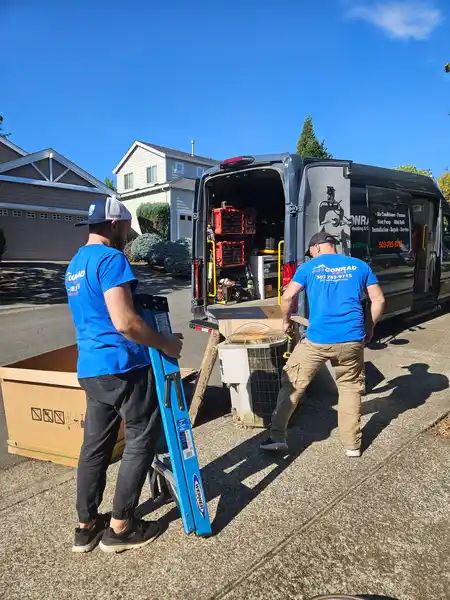
Most calls before 5 PM are on the same-day schedule across the Portland metro. After hours, the emergency line goes to a live person. Most emergency calls are on-site within 2 hours — the proximity of a Beaverton base helps.

Upfront Pricing, Free Estimates
Diagnostic first, written quote second, work third. Free estimates on repair calls. The number after the diagnostic is the number on the invoice — no additions at the end without a phone call first.

All Home Heating Systems Serviced
Gas furnaces, electric furnaces, heat pumps, ductless mini-splits — all brands, all ages. Technicians trained on each system type, not defaulting to “might need replacement” when the repair gets technical.