

Here’s something most homeowners find out after they’ve already signed a quote: Bryant and Carrier are the same company. Same parent — Carrier Global Corporation. Same factories. Often the same compressor sitting inside a different cabinet.
That doesn’t make the choice meaningless. But it does change what you should actually be comparing.
Quick Answer — Bryant or Carrier?
Bryant runs about 10–15% cheaper. Carrier’s top-tier Infinity systems are noticeably quieter and have better diagnostics. Everything in the middle of both lineups is nearly interchangeable.
If you’re replacing a 15-year-old system in a 1,800 sq ft house and you want reliable heat without overpaying for features you’ll never use — Bryant. If noise matters (unit outside a bedroom window, small lot), or you want the system to self-diagnose before calling you at 11pm — Carrier Infinity.
The rest of this article explains why — and if Bryant and Carrier both feel like a coin flip, there’s a section near the end on why our Oregon technicians often recommend a third brand instead.
Bryant and Carrier — One Manufacturer, Two Brands
Carrier Global didn’t acquire Bryant. They created it — as a lower-price entry point to reach customers who’d balk at the Carrier price tag. Same engineering team designed both lineups. In many cases, the same assembly line built them.
How Bryant and Carrier Are Connected
Pull the service manual on a Bryant Evolution 280A heat pump and a Carrier Infinity 24. The compressor specs, refrigerant charge tables, and control board part numbers overlap heavily. This isn’t a coincidence or a cost-cutting shortcut — it’s intentional product architecture. Carrier Global also owns Payne, which sits one tier below Bryant. Three brands, one engineering budget. If you’re shopping on value, it’s worth knowing that RUUD — owned by Rheem, a completely separate company — sits in a similar price range with a different supply chain and parts ecosystem entirely.
What this means practically: a technician certified on Carrier systems can work on Bryant without retraining. Many replacement parts are interchangeable across matching tiers. And when one brand’s part is backordered three weeks out, a contractor with experience on both can often source the equivalent from the other side of the catalog.
How Each Brand Is Positioned in the Market
Carrier is the flagship — premium marketing, stricter dealer certification requirements, higher MSRP. Bryant is positioned as the value alternative, distributed through a broader and somewhat less exclusive dealer network.
The price gap shows up most at the entry level. At the top — Infinity vs Evolution — the difference is mainly the cabinet insulation and control system polish, not the core mechanical components. Worth knowing before a contractor charges you $800 extra because “Carrier is just better quality.”
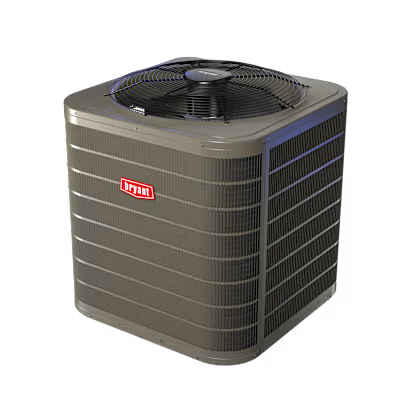
Bryant vs Carrier Air Conditioners Compared
The full lineup runs from single-stage 14 SEER2 entry units up to variable-speed systems that hit 26 SEER2. Most homeowners end up somewhere in the middle.
AC Model Lineups — Infinity vs Evolution
| Model | Brand | SEER2 | Compressor | Installed Price (est.) |
| Infinity 26 | Carrier | Up to 26 | Variable-speed | $5,500–$9,000 |
| Performance 17 | Carrier | Up to 17 | Two-stage | $3,800–$6,200 |
| Comfort 14 | Carrier | Up to 14.3 | Single-stage | $2,800–$4,500 |
| Evolution 26 | Bryant | Up to 26 | Variable-speed | $5,000–$8,200 |
| Preferred 18 | Bryant | Up to 18 | Two-stage | $3,500–$5,800 |
| Legacy 14 | Bryant | Up to 14.3 | Single-stage | $2,500–$4,100 |
The Comfort 14 and Legacy 14 at the bottom of each lineup? Functionally the same unit. Don’t let a contractor tell you otherwise. At this tier especially, it’s worth getting a RUUD quote alongside — the entry-level price points are comparable, and the parts ecosystem is independent of Carrier Global entirely.
Variable-speed matters more than the SEER2 number. A 26 SEER2 system running at 40% capacity on a mild day genuinely saves money. A 20 SEER2 single-stage unit blasting at 100% every cycle doesn’t — the headline rating assumes ideal conditions that don’t exist in a real house. If your budget can stretch to a two-stage or variable-speed compressor, that’s where the efficiency gain actually lives.
One thing Carrier’s Infinity system does better: communicating diagnostics. The control board logs fault codes and, if your contractor has Carrier’s remote monitoring set up, they can see a developing problem before it becomes a breakdown. Bryant’s Evolution line has similar capability, but Carrier’s implementation is more polished.
Bryant vs Carrier Furnaces Compared
Oregon winters are mild compared to Montana — but they run long, damp, and variable. Your furnace might cycle 600–800 hours between November and March. That’s where efficiency choices show up on your gas bill.
Furnace Efficiency and Model Breakdown
| Model | Brand | AFUE | Burner | Heat Exchanger Warranty |
| Infinity 98 | Carrier | 98.5% | Modulating | 20 years |
| Performance 96 | Carrier | 96.5% | Two-stage | 20 years |
| Comfort 80 | Carrier | 80% | Single-stage | 20 years |
| Evolution 986M | Bryant | 98.3% | Modulating | 20 years |
| Preferred 926T | Bryant | 96% | Two-stage | 20 years |
| Legacy 80 | Bryant | 80% | Single-stage | 20 years |
At 80% AFUE, 20 cents of every gas dollar goes up the flue. At 96–98%, you’re recovering most of that. Over 10 years in Beaverton, the difference between an 80% and a 96% furnace can exceed $3,000 in gas costs — more than enough to offset the higher upfront price.
Which Furnace Works Better in Oregon’s Climate
Single-stage furnaces fire at 100% every cycle. In a climate where outdoor temps hover between 35–45°F for weeks at a time, that means the furnace overshoots the setpoint, shuts off, and the house cools back down before the next cycle. Repeat 20 times a day. Your floors are cold, your humidity bounces around, and the heat exchanger is cycling thermal stress it doesn’t need.
A modulating furnace — the Carrier Infinity 98 or Bryant Evolution 986M — can run at 40% capacity during mild weather. Longer, quieter cycles. Temperature holds within about half a degree of setpoint. This is where “comfort” stops being a marketing word and becomes a physical reality you notice.
One practical note before any furnace installation near Beaverton: if your contractor services multiple brands, ask them to quote RUUD alongside Bryant or Carrier. At the 96%+ AFUE tier, the mechanical performance is comparable — and in our experience, RUUD parts run cheaper and arrive faster when service is needed down the road.
Bryant vs Carrier Heat Pumps Compared
Heat pumps are the fastest-growing replacement category in Oregon right now, and the economics have shifted enough that they make sense for most homes in the Portland metro — not just as an environmental choice, but as a financial one. Federal tax credits under the Inflation Reduction Act cover up to $2,000. Energy Trust of Oregon stacks additional rebates on top. On a $7,000 install, that can reduce your out-of-pocket to under $5,000.
Key Heat Pump Models Side by Side
| Model | Brand | HSPF2 | SEER2 | Cold Limit | Sound |
| Infinity 24 | Carrier | 10.0 | 24 | −13°F | ~51 dB |
| Performance 18 | Carrier | 8.2 | 18 | 0°F | ~56 dB |
| Evolution 280A | Bryant | 10.0 | 24 | −13°F | ~56 dB |
| Preferred 226B | Bryant | 8.1 | 18 | 5°F | ~58 dB |
HSPF2 is the heating efficiency rating. At 10.0 HSPF2, these systems deliver roughly 3 units of heat per unit of electricity — 300% efficiency. No gas furnace gets close to that.
Heat Pumps in the Pacific Northwest — What Matters Most
The Portland metro sees fewer than 10 days a year below 25°F. That’s important because heat pump efficiency drops in deep cold — but at Oregon temperatures, a standard cold-climate unit handles the full heating load most of the season without backup strips running.
The smarter setup for most Oregon homes is dual-fuel: heat pump as the primary system, existing gas furnace as backup. Below about 35°F, gas becomes more cost-effective per BTU. Above that — which is most of your heating season — the heat pump runs the show. The Carrier Infinity Touch thermostat and compatible Ecobee units handle the switchover automatically based on outdoor temperature.
For heat pump installation in Beaverton, ask about refrigerant before you sign anything — and if you haven’t compared RUUD at this stage, it’s worth a look. RUUD heat pumps carry a 10-year parts warranty with registration and a separate supply chain from Carrier Global, which affects both parts cost and lead times if something needs replacing in year six.
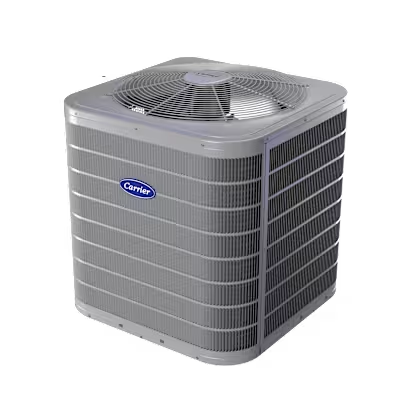
Cost and Installation Pricing — Bryant vs Carrier
Price Difference Between Bryant and Carrier
Bryant runs 10–15% less than comparable Carrier equipment. On a $6,500 system, that’s $650–$975 less for hardware sharing the same compressor platform. The gap is widest at the mid tier — Performance vs Preferred — and narrows at the top, where Evolution and Infinity pricing converges.
What Affects the Total Cost of an HVAC System
| System Type | Bryant (installed) | Carrier (installed) |
| Central AC — mid-tier | $3,500–$5,800 | $3,800–$6,200 |
| High-efficiency furnace | $3,200–$5,500 | $3,500–$6,000 |
| Variable-speed heat pump | $5,000–$8,200 | $5,500–$9,000 |
These numbers assume a straightforward swap — same location, existing ductwork in decent shape, standard electrical. Three things that regularly push the number higher:
Ductwork. If it hasn’t been tested or sealed in 15 years, budget $500–$2,000 for sealing and any needed modification. A new high-efficiency system losing 25–30% of its output through leaky ducts is a common and expensive mistake.
Electrical panel. Heat pumps sometimes require a panel upgrade when replacing a gas-only system. That’s a $1,500–$3,500 line item that belongs in any honest quote.
Oregon rebates. Energy Trust of Oregon publishes current rebate amounts on their website. Check before selecting equipment — some models qualify for higher rebates that can shift the Bryant vs Carrier price math.
Getting two or three quotes for any AC installation in Beaverton tells you more than just price — it shows you how different contractors are structuring the job, what equipment tier they’re recommending, and whether anyone is padding margin on the equipment side. If one of those quotes includes RUUD, you’ll have a useful data point outside the Carrier Global ecosystem entirely.
Bryant vs Carrier Warranty — What’s Covered
Bryant vs Carrier Warranty Comparison Table
| Coverage | Bryant | Carrier | RUUD |
| Parts — registered | 10 years | 10 years | 10 years |
| Parts — unregistered | 5 years | 5 years | 5 years |
| Heat exchanger | 20 years | 20 years | Lifetime (select models) |
| Compressor (top-tier models) | 10 years | 10 years | 10 years |
| Transferable to new owner | Yes | Yes | Yes |
Registration is the detail that bites people. Both brands cut the parts warranty from 10 years to 5 if you don’t register within 90 days of installation. Your installer should handle it — but follow up and get confirmation. It takes five minutes and costs a decade of coverage if it doesn’t happen.
The 20-year heat exchanger warranty is real protection — though worth noting that RUUD offers a lifetime heat exchanger warranty on select high-efficiency furnaces, which is a longer coverage window than either Bryant or Carrier at comparable price points.
Build Quality, Noise, and Energy Efficiency
Noise Levels — Actual dB Comparison
- Carrier Infinity 26 AC / Infinity 24 heat pump: ~51 dB
- Bryant Evolution 26 AC / Evolution 280A heat pump: ~56 dB
- Mid-tier units across both brands: 57–62 dB range
Five decibels sounds like a minor spec difference. It isn’t — decibels are logarithmic, so 56 dB is perceived as roughly twice as loud as 51 dB. If the unit sits under a bedroom window or on a small lot where your neighbor’s kitchen is 15 feet away, that difference matters every night for the next 15 years. Bryant’s cabinet uses slightly thinner insulation — a deliberate cost trade-off that most installations won’t notice, but noise-sensitive situations will.
Energy Efficiency — SEER2 and AFUE Side by Side
Both brands hit the same peaks: 26 SEER2 at the top of the AC lineup, 98+ AFUE on the highest-efficiency furnaces. Mid-tier lands at 17–18 SEER2. Entry-level clears the 14 SEER2 federal floor and not much else.
The compressor type predicts real-world efficiency more accurately than SEER2 ratings. Variable-speed systems modulate output to match actual load — they spend most of their time at partial capacity, which is where efficiency gains compound. A fixed-stage unit hits its rated SEER2 only under standardized test conditions that don’t reflect how your house actually loads the system.
Who Should Choose Bryant and Who Should Choose Carrier
Choose Bryant If…
- You want 96%+ AFUE or 18+ SEER2 without paying for features that live in the control system, not the mechanical components
- Budget is real and you’re not going to use smart home integration or remote diagnostics
- Your contractor installs Bryant regularly — local service familiarity is worth more than brand loyalty
- You’re planning to sell in the next 7–8 years; the transferable warranty makes Bryant a solid asset without over-investing
- Your contractor works with multiple brands and recommends Bryant specifically — local parts availability or installer familiarity often outweighs brand differences at this tier
Choose Carrier If…
- The unit is going somewhere noise-sensitive — the Infinity series is genuinely quieter at ~51 dB
- You want the Infinity communicating system’s diagnostics — it’s the closest thing to predictive maintenance available in residential HVAC
- Smart home integration matters: Carrier’s ecosystem connects cleanly with Alexa, Google Home, and their own Infinity Touch thermostat
- You’re staying 10+ years and want the most complete warranty and dealer support structure — though at this horizon, also compare RUUD’s lifetime heat exchanger warranty before making a final call
Neither is the wrong choice. The installation matters more than the nameplate — a properly commissioned Bryant system will outperform a carelessly installed Carrier every time. Refrigerant charge off by 10%, airflow not balanced, duct leakage untested — these cause more service calls than anything you’ll decide in a showroom.
FAQ — Bryant vs Carrier
Are Bryant and Carrier made by the same company? Yes. Carrier Global Corporation owns both brands. They share manufacturing facilities and engineering teams, and many internal components are interchangeable across matching product tiers.
Which is cheaper — Bryant or Carrier? Bryant runs 10–15% less on comparable models. The gap is widest at mid-tier; at the top of each lineup (Evolution vs Infinity), pricing converges closer to 8–10%.
Can you use Carrier parts on a Bryant system? Often, yes — particularly on matching tiers. Your technician should verify compatibility before ordering, but it’s a common workaround when one brand’s part is on a 3-week backorder.
Which brand runs quieter? Carrier’s Infinity series, at ~51 dB. Bryant Evolution runs ~56 dB. At mid-tier and below, the gap is smaller and varies by model. If noise is the deciding factor, compare specific model spec sheets — don’t rely on tier names alone.
Which HVAC brand is better for Oregon homes? For heat pumps — the right call for most Oregon homes given the climate and available rebates — the top-tier units are functionally equivalent. Carrier Infinity 24 and Bryant Evolution 280A share the same HSPF2 rating and cold-climate performance. Bryant saves money upfront; Carrier is quieter and has more refined controls. For furnaces, efficiency tier matters more than brand — get 96%+ AFUE modulating regardless of the nameplate, then choose on price and installer availability.
Is RUUD worth comparing alongside Bryant and Carrier? If you’re still comparing options, yes. RUUD is owned by Rheem — a separate company from Carrier Global — which means an independent supply chain, generally lower parts costs, and in our Oregon service experience, fewer repeat repairs in the 5–10 year window. It doesn’t have the same brand recognition as Carrier, but for homeowners focused on long-term cost of ownership, it’s worth getting a quote alongside Bryant and Carrier before deciding.
Once the system is in, keep up with it. Annual tune-ups, filter changes, coil cleaning. The units that hit 18–20 years aren’t always the most expensive ones — they’re the ones that get HVAC maintenance services on schedule. That’s true whether the nameplate says Bryant, Carrier, or RUUD.

 (503) 785-9715