
When Oregon homeowners compare HVAC systems, three names come up most often: Carrier, Bryant, and RUUD. Two of those are actually the same equipment. One stands apart on reliability, parts cost, and long-term value. This guide breaks it all down.
First: Bryant and Carrier Are the Same Brand
Before comparing Carrier and RUUD, one thing worth knowing: Bryant and Carrier are owned by the same parent company — Carrier Global Corporation. They share engineering teams, factories, and in many cases the exact same compressor platform and control boards across matching product tiers.
Bryant is positioned as the value segment, Carrier as the flagship. The price gap is real — Bryant typically runs 10–15% less than a comparable Carrier system — but the internal components are nearly identical. A technician certified on Carrier systems can work on Bryant without retraining. Replacement parts often cross over between brands.
What this means practically: everything said about Carrier in this comparison applies equally to Bryant and Carrier systems. When we reference Carrier below, Bryant owners are in the same boat.
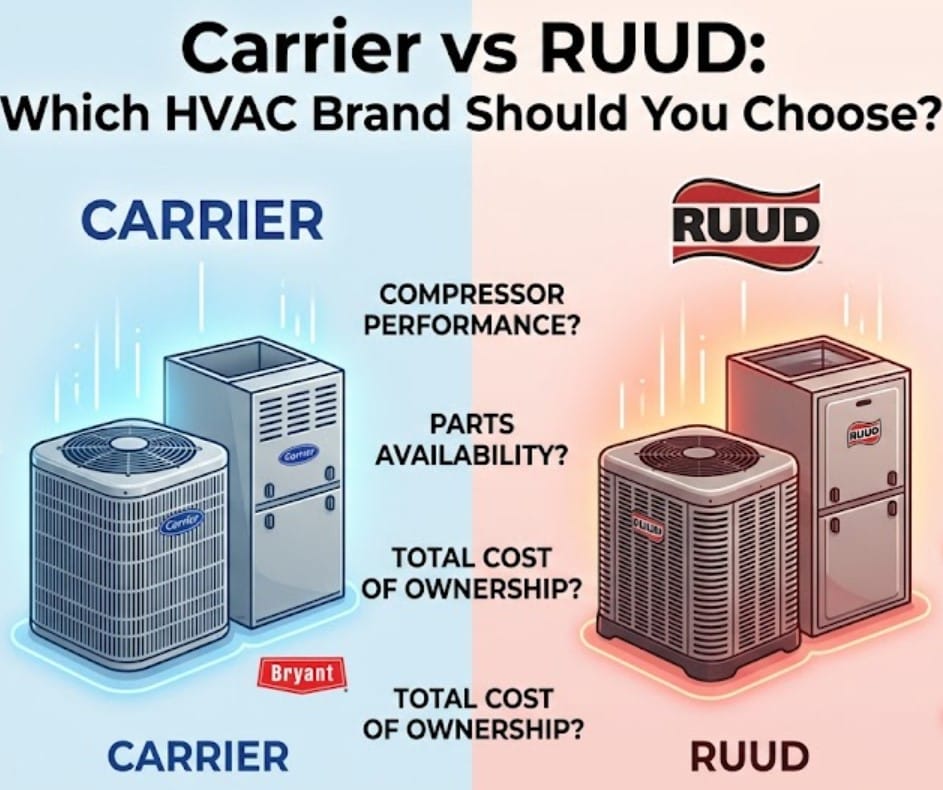
Quick Answer — Carrier/Bryant or RUUD?
Based on our installation and service experience across Oregon: RUUD systems show more consistent long-term reliability, lower repair costs, and faster parts availability than Carrier or Bryant. For most homeowners in the Portland metro, RUUD offers better overall value.
Carrier and Bryant remain solid, well-known brands with strong dealer networks. If you have a long-standing relationship with a Carrier contractor or specific features matter to you (like Carrier’s Infinity communicating system), those are legitimate reasons to choose Carrier. But on the fundamentals — durability, cost of ownership, and serviceability — RUUD has the edge in our field experience.
Real-World Reliability: What We See in the Field
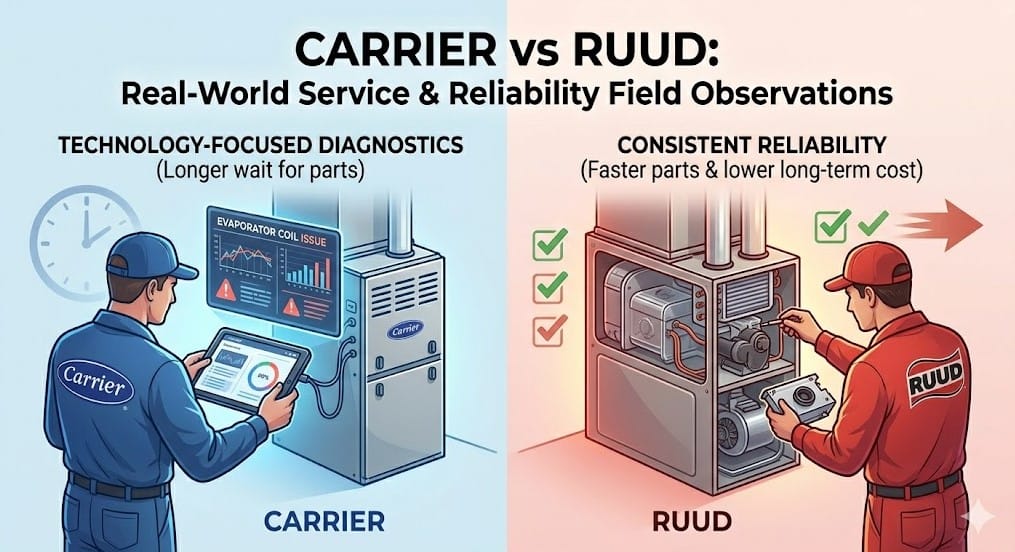
After years of installing and servicing HVAC systems across Oregon, our technicians have noticed clear patterns between brands. These aren’t manufacturer claims — they’re what shows up on actual service calls.
RUUD
- Consistent long-term reliability across installations
- Fewer service-related issues observed over time
- Systems regularly operate 15–20+ years with proper maintenance
- Strong and consistent compressor performance
Carrier / Bryant
- Higher frequency of service calls observed in recent years
- More refrigerant-related issues, including evaporator coil concerns
- Compressor-related problems in some systems leading to costly repairs
- Some systems require repairs sooner than expected depending on usage and conditions
These observations come from direct installation and service experience in the Oregon market. Every brand has outliers — a well-maintained Carrier system can outlast a neglected RUUD. But patterns across hundreds of service calls show RUUD trending toward fewer major repairs.
Carrier vs RUUD Air Conditioners Compared
Both brands cover the full range from entry-level single-stage units to variable-speed systems hitting 22–26 SEER2. On paper the numbers are close. The differences show up when something goes wrong.
AC Model Lineups Side by Side
| Model | Brand | SEER2 | Compressor | Installed Price (est.) |
|---|---|---|---|---|
| Infinity 26 | Carrier | Up to 26 | Variable-speed | $5,500–$9,000 |
| Performance 17 | Carrier | Up to 17 | Two-stage | $3,800–$6,200 |
| Comfort 14 | Carrier | Up to 14.3 | Single-stage | $2,800–$4,500 |
| RA16AZ | RUUD | Up to 22 | Variable-speed | $5,000–$8,500 |
| RA15PZ | RUUD | Up to 18 | Two-stage | $3,500–$6,000 |
| RA14AZ | RUUD | Up to 14.3 | Single-stage | $2,600–$4,300 |
On paper, SEER2 ratings are comparable across both brands at each tier. The real-world difference shows up in service history. RUUD’s compressors have demonstrated more consistent performance in our Oregon installations. Carrier’s Infinity variable-speed units offer excellent diagnostics through their communicating system — but that advantage is reduced if the system requires more frequent service calls to begin with.
For Bryant vs RUUD comparisons: since Bryant shares Carrier’s mechanical platform, the same reliability patterns apply. Bryant’s Evolution line and Carrier’s Infinity line use the same core components — and the same service trends follow.
Carrier vs RUUD Furnaces Compared
Furnace efficiency tiers are nearly identical across both brands — but warranty coverage and real-world service experience tell a different story. Here’s how the lineups stack up.
Furnace Efficiency and Model Breakdown
| Model | Brand | AFUE | Burner | Heat Exchanger Warranty |
|---|---|---|---|---|
| Infinity 98 | Carrier | 98.5% | Modulating | 20 years |
| Performance 96 | Carrier | 96.5% | Two-stage | 20 years |
| Comfort 80 | Carrier | 80% | Single-stage | 20 years |
| R98MV | RUUD | 98% | Modulating | Lifetime |
| R96VA | RUUD | 96% | Two-stage | Lifetime |
| R802V | RUUD | 80% | Single-stage | Lifetime |
Both brands cover the full AFUE range from 80% to 98%+. The standout difference: RUUD offers a lifetime heat exchanger warranty on many high-efficiency furnace models. Carrier and Bryant offer 20 years. That’s a meaningful gap — a cracked heat exchanger can mean a $1,500–$3,500 repair bill or a recommendation to replace the entire system.
Which Furnace Works Better in Oregon’s Climate
Oregon winters are long, damp, and moderate — outdoor temperatures hover between 35–45°F for weeks at a time. A single-stage furnace fires at 100% every cycle, overshoots the setpoint, shuts off, and repeats. Your floors stay cold, humidity bounces, and the heat exchanger cycles unnecessary thermal stress.
A modulating furnace — whether RUUD’s R98MV or Carrier’s Infinity 98 — runs at 40–60% capacity during mild weather. Longer, quieter cycles. Temperature holds within half a degree. For Oregon homes, this is where comfort stops being a marketing word.
Before any furnace installation near Beaverton, have your contractor test duct static pressure. Old ductwork that’s too restrictive chokes a modulating furnace — efficiency gains disappear and the system runs louder than spec. This applies regardless of brand.
Carrier vs RUUD Heat Pumps Compared
Heat pumps are the fastest-growing replacement category in Oregon right now. Federal credits and Energy Trust rebates have made them the financially smart choice for most Portland metro homes. Both RUUD and Carrier offer strong cold-climate units — the differences come down to noise, diagnostics, and what happens at repair time.
Key Heat Pump Models Side by Side
| Model | Brand | HSPF2 | SEER2 | Cold Limit | Sound |
|---|---|---|---|---|---|
| Infinity 24 | Carrier | 10.0 | 24 | −13°F | ~51 dB |
| Performance 18 | Carrier | 8.2 | 18 | 0°F | ~56 dB |
| RP20AZ | RUUD | 10.0 | 22 | −13°F | ~55 dB |
| RP15AZ | RUUD | 8.5 | 18 | 5°F | ~58 dB |
Top-tier RUUD and Carrier heat pumps are closely matched on efficiency — both hit HSPF2 ratings around 10.0 and handle cold-climate performance down to −13°F. Carrier’s Infinity 24 is slightly quieter at 51 dB vs RUUD’s ~55 dB. If the unit sits under a bedroom window, that difference is noticeable.
Where RUUD pulls ahead is long-term parts cost and availability. When a heat pump needs a repair at year 8, RUUD components are often available within 2–3 business days. Some Carrier and Bryant parts take 2–3 weeks. In Oregon, that’s 2–3 weeks without heat or cooling.
Heat Pumps in the Pacific Northwest — What Matters Most
The Portland metro sees fewer than 10 days a year below 25°F. That’s important because heat pump efficiency drops in deep cold — but at Oregon temperatures, a standard cold-climate unit handles the full heating load most of the season without backup strips running.
Federal tax credits under the Inflation Reduction Act cover up to $2,000 for qualifying heat pump installations. Energy Trust of Oregon stacks additional rebates on top. On a $7,000 install, that can reduce out-of-pocket costs to under $5,000. Both RUUD and Carrier models qualify — check the Energy Trust website for current eligible equipment lists before signing anything.
For heat pump installation in Beaverton, ask your contractor about refrigerant before you sign. New systems are transitioning from R-410A to R-454B as EPA phasedown rules take effect. R-410A systems are still being installed and will be serviceable for years — but parts availability will tighten over the next decade.
Parts Cost and Long-Term Maintenance
One of the most significant differences between RUUD and Carrier/Bryant shows up not at purchase time — but at the first repair.
| Category | RUUD | Carrier / Bryant |
|---|---|---|
| Parts cost | Often 2–3x cheaper | Higher replacement costs |
| Availability | 2–3 business days (typical) | 2–3 weeks (some parts) |
| Long-term maintenance | Lower overall cost | Can add up over time |
These aren’t industry estimates — they reflect what we encounter on actual service calls in Oregon. The parts gap is especially noticeable on compressors and control boards, where Carrier and Bryant components carry a premium that RUUD equivalents don’t.
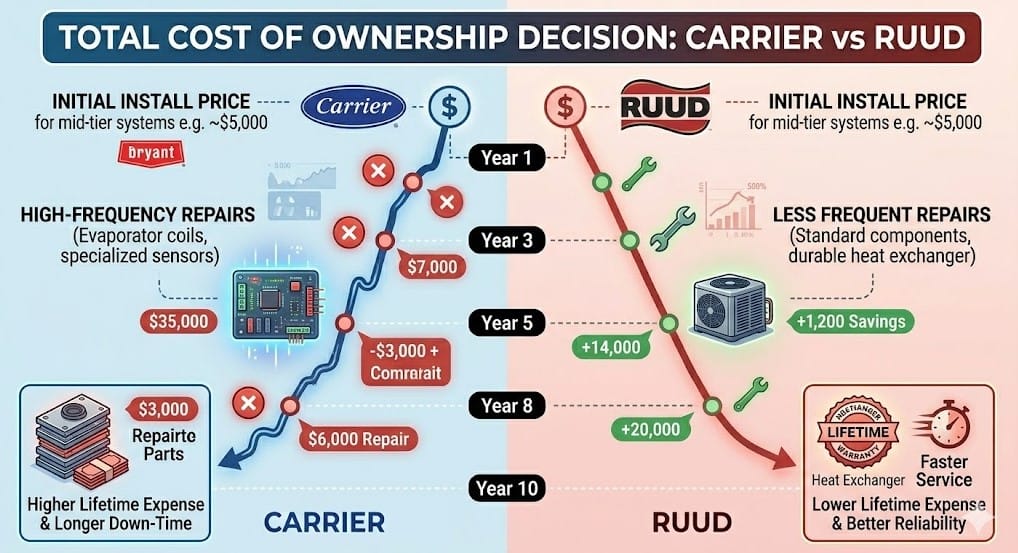
Cost and Installation Pricing — Carrier vs RUUD
| System Type | RUUD (installed) | Carrier (installed) |
|---|---|---|
| Central AC — mid-tier | $3,500–$6,000 | $3,800–$6,200 |
| High-efficiency furnace | $3,200–$5,500 | $3,500–$6,000 |
| Variable-speed heat pump | $5,000–$8,500 | $5,500–$9,000 |
Upfront pricing is comparable — RUUD often runs slightly less than Carrier at mid-tier, closer to even at the top. The more meaningful cost difference emerges over 5–10 years of ownership: fewer service calls, cheaper parts, and faster repairs with RUUD consistently produce lower total cost of ownership in our experience.
Three things regularly push the total installation number higher regardless of brand:
- Ductwork — if it hasn’t been tested or sealed in 15 years, budget $500–$2,000. A new high-efficiency system losing 25–30% of output through leaky ducts is a common and expensive mistake.
- Electrical panel — heat pumps replacing gas-only systems sometimes require a panel upgrade: $1,500–$3,500.
- Oregon rebates — Energy Trust of Oregon publishes current rebate amounts. Check before selecting equipment — some RUUD models qualify for higher rebates that can shift the price math.
Getting two quotes for any AC installation in Beaverton tells you more than price alone — it shows how different contractors structure the job, what equipment tier they recommend, and whether anyone is padding margin on the equipment side.
Carrier vs RUUD Warranty — What’s Covered
Both brands require registration within 90 days of installation to activate full coverage. Your installer should handle this — but follow up and get confirmation. One missed step cuts the parts warranty from 10 years to 5.
Warranty Comparison Table
| Coverage | RUUD | Carrier / Bryant |
|---|---|---|
| Parts — registered | 10 years | 10 years |
| Parts — unregistered | 5 years | 5 years |
| Heat exchanger | Lifetime (high-efficiency models) | 20 years |
| Compressor (top-tier) | 10 years | 10 years |
| Transferable to new owner | Yes | Yes |
Both brands require registration within 90 days to activate the full 10-year parts warranty — your installer should handle it, but follow up and get confirmation. The meaningful difference is the heat exchanger: RUUD’s lifetime warranty on high-efficiency furnaces vs Carrier’s 20 years is a real advantage if you’re planning to stay in the home long-term.
Who Should Choose RUUD and Who Should Choose Carrier
The right answer depends on what matters most to you — upfront features, long-term cost, or service experience. Here’s how to think through it.
Choose RUUD If…
- Reliability and low long-term maintenance cost are your top priorities
- You want faster service turnaround when something goes wrong
- Parts cost matters — RUUD components are typically 2–3x less expensive
- You want a lifetime heat exchanger warranty on your furnace
- Budget-conscious without sacrificing efficiency — RUUD hits the same SEER2 and AFUE benchmarks as Carrier
Choose Carrier If…
- The Infinity communicating system’s diagnostics matter to you — it’s the most polished remote monitoring available in residential HVAC
- Noise is a factor — Carrier’s Infinity series runs at ~51 dB, meaningfully quieter than comparable RUUD units
- Smart home integration is a priority — Carrier connects cleanly with Alexa, Google Home, and their Infinity Touch thermostat
- You have a long-standing relationship with a local Carrier dealer whose service you trust
Neither is the wrong choice — but for most Oregon homeowners weighing reliability and total cost of ownership, RUUD has the clearer advantage based on what we see in the field.
FAQ — Carrier vs RUUD
Are Carrier and Bryant the same brand?
Yes. Both are owned by Carrier Global Corporation and share engineering teams, factories, and core components across matching product tiers. Bryant is positioned as the value option; Carrier is the flagship. When comparing either to RUUD, the same reliability and service patterns apply to both.
Is RUUD more reliable than Carrier?
Based on our installation and service experience in Oregon: yes. RUUD systems have shown fewer major repairs, more consistent compressor performance, and lower long-term maintenance costs than Carrier and Bryant systems in our market.
Which is cheaper — RUUD or Carrier?
Upfront costs are comparable. RUUD often runs slightly less at mid-tier. Over 5–10 years, RUUD typically produces lower total cost of ownership due to cheaper parts and fewer service calls.
How does RUUD compare to Bryant?
Since Bryant and Carrier share the same mechanical platform, the Carrier vs RUUD comparison applies directly to Bryant vs RUUD as well. RUUD shows better reliability and lower repair costs vs both Bryant and Carrier in our field experience.
Which brand has better parts availability?
RUUD. Many RUUD parts are available within 2–3 business days. Some Carrier and Bryant parts — particularly for newer models — can take 2–3 weeks. In Oregon, that wait time matters when your system is down in January.
Which HVAC brand is better for Oregon homes?
For most Oregon homeowners, RUUD offers the best combination of reliability, parts availability, warranty coverage, and long-term cost. Carrier’s Infinity system is worth considering if diagnostics and smart home integration are priorities. For heat pumps specifically — the right call for most Oregon homes given the climate and available rebates — top-tier RUUD and Carrier units are closely matched on efficiency; RUUD has the edge on service cost.
Does RUUD qualify for Oregon rebates?
Yes. Energy Trust of Oregon lists qualifying equipment on their website, and many RUUD models meet the criteria. Federal tax credits under the Inflation Reduction Act also apply to qualifying RUUD heat pump installations. Check the current lists before selecting equipment — eligible models change as efficiency standards update.
Once the system is in, keep up with it. Annual tune-ups, filter changes, coil cleaning. The units that hit 18–20 years aren’t always the most expensive ones — they’re the ones that get HVAC maintenance services on schedule. That’s true whether the nameplate says Carrier, Bryant, or RUUD.

 (503) 785-9715